Quake: 30th Anniversary
Exactly 30 years ago, on June 22, 1996, one of the greatest games of all time was released. It was Quake, a legend of the 90s and an all-time classic of the first person shooter genre. Quake is the originator of one of the most successful game series, with over 4 million copies sold between Quake, Quake II, and Quake III: Arena.
With the advent of Quake, the concept of eSports was born, and major championships began to be held. Thanks to Quake's popularity, the first eSports league, the Cyberathlete Professional League (CPL), was established in the United States in 1997. Even today's eSports masters, wiping away tears, recall that in terms of deathmatch, the original Quake remains unrivaled by any game (perhaps only by its sequel, Quake II).
Quake's plot is straightforward. The protagonist is a nameless soldier sent on a mission to destroy an unknown enemy that is sending legions of monsters to Earth through a teleportation gate. You must travel through this gate to a bizarre, gothic parallel dimension and destroy the Evil. "Quake" is the codename for the game's main boss, Shub-Niggurath, who hails from the horror universe of H.P. Lovecraft. However, in Quake, this creature more closely resembles one of her descendants than Shub-Niggurath herself.
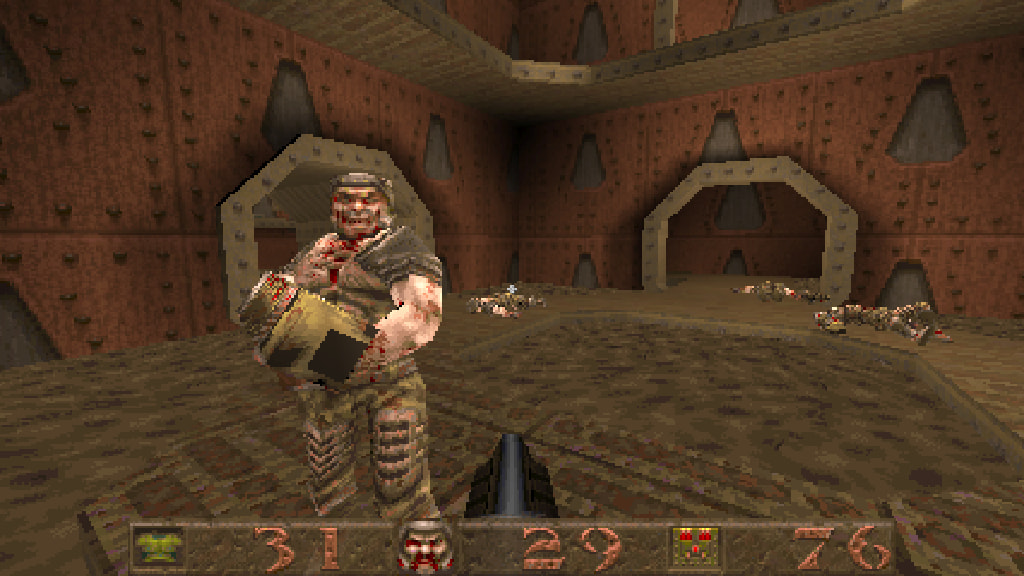
The Quake graphics engine was one of the world's first fully polygonal 3D engines. It was a true revolution in the world of gaming graphics. It's hard to believe, but the Quake engine, in one form or another, is still used today: it formed the basis of Half-Life and numerous popular mods. After id Software open-sourced Quake and Quake II, numerous free games using these technologies appeared.
The Quake Engine is sometimes referred to as id Tech 1, the first version of id Software's in-house engine. It was written by John Carmack in 1996 in C specifically for the game Quake. Michael Abrash was also involved in the development, assisting Carmack with algorithms and code optimization. Initially, the engine supported DOS and Windows, but its Open Source nature and use of OpenGL ultimately led to Quake being ported to virtually every platform capable of any 3D graphics.
The implementation of maps in Quake Engine is interesting: game levels for the engine are modeled using Constructive Solid Geometry. This approach was inherited by Valve in their Source engine. Level walls are constructed from simple convex geometric objects called brushes. Brushes are placed and rotated to create enclosed rooms. The map is then run through a special preprocessor, which removes "excess" geometry and leaves only those polygons that will be visible to the player from within the map.
A map processed this way has a significantly lower polygon count, but culling invisible geometry was time-consuming: on computers of that era, this operation could take up to several hours! Situations often arose where the preprocessor could not complete its work due to random holes connecting the interior of the map with the exterior—so-called "leaks." Finding and eliminating these "leaks," formed between several carelessly joined objects, was a difficult task for the designer.
But how then, the reader might ask, is the sky and clouds visible in some maps implemented? In fact, the windows and holes in the ceiling through which the skybox is visible are simply formed by invisible brushes—there are no "leaks" in this case. Incidentally, some particularly advanced cheaters exploited this feature by editing the map, adding additional windows to see other players' movements.
Another id Software invention, first tested in Quake, is static lightmaps: instead of recalculating the illumination of stationary objects each frame, a texture with pre-calculated shadows and highlights is used. This technique has since been used in games, although it is now obsolete and is being replaced by fully real-time GPU lighting.
Maps for the Quake series and many other games in its family are traditionally modeled using the GtkRadiant editor. This free program, licensed under the GPL, has its roots in id Software's proprietary tools. One of these was QuakeEd, the first Quake map editor for the NeXTSTEP operating system.
GtkRadiant's first direct ancestor is QE4, a map creation tool for Quake II, which was included with the Quake II SDK. When the company open-sourced QE4, enthusiasts developed the popular QERadiant editor based on it. id Software used it as the basis for Q3Radiant, a map editor for Quake III Arena.
GtkRadiant, first released in 2001, is a fork of Q3Radiant that incorporated two major changes: the use of GTK+, which provided support for Linux and Mac OS X, and independence from id Software technologies, allowing maps to be created for any game. GtkRadiant now supports not only Quake I, II, III, and IV, but also Return to Castle Wolfenstein, the Star Wars Jedi Knight series, parts of Call of Duty, and many others.
The Quake engine was one of the first PC games to support hardware 3D acceleration. Initially, the 3D graphics were processed entirely on CPU, but Carmack later added support for the Rendition Vérité 1000 graphics card, a version called VQuake. The engine was then rewritten using OpenGL, giving birth to GLQuake, which became the first application to practically demonstrate the capabilities of the 3DFX Voodoo chipset.
Besides its revolutionary graphics technology at the time, the Quake Engine is also notable for being, essentially, the first open-architecture engine. This meant that anyone could modify the game beyond recognition, changing resources and flexibly customizing the behavior of game objects using a special scripting language (Quake C). The engine included a console with its own command system, an idea subsequently adopted by other developers. The modding culture owes much to Quake, it was one of the first games to have third-party modifications released, adding new locations, weapons, characters, and introducing new gameplay rules. For example, in the multiplayer mod HeadHunters, players had to deliver the head of a slain enemy to an altar – the more heads you turned in at once, the more kills you got.
Many Quake mod developers subsequently founded their own companies in the market. One example is Ritual Entertainment, which developed the official expansion for the first Quake, and subsequently other independent projects, such as the shooter SiN.
What else was born as a Quake mod? It's, of course, the well-known multiplayer shooter Team Fortress. Its first version was created by Australians Robin Walker, John Cook, and Ian Caughley in 1996. The mod was so successful that Walker, Cook, and Caughley founded their own company, TeamFortress Software, and planned to create a sequel to Team Fortress 2, a commercial mod for Quake II.
However, in 1998, they were acquired by Valve, and development of Team Fortress 2 continued using the Half-Life engine. Ultimately, the game was released as Team Fortress: Brotherhood in Arms. Team Fortress 2's release was delayed, and its engine was reworked to create Half-Life 2. This engine was later renamed the Source Engine. TF2 was released only in 2006 as part of The Orange Box, a compilation that also included such iconic titles as Portal and Half-Life 2: Episode Two.
As for Half-Life itself, it originated not as a mod, but as a game based on the licensed Quake engine. The game's creators, former Microsoft programmers Gabe Newell and Mike Harrington, dreamed of creating a terrifying 3D shooter about an alien invasion. Initially, the game was called Quiver and was based on Stephen King's novella "The Mist." The television series "The X-Files" also influenced the concept of the future game.
The final name, Half-Life, was taken from physics terminology. The game follows the adventures of scientist Gordon Freeman at the Black Mesa research facility, which is attacked by monsters from a parallel world.
The Half-Life engine was named GoldSource (or GoldSrc). It's based on the code of QuakeWorld, an updated version of Quake with an improved multiplayer mode. Incidentally, it was none other than Michael Abrash, one of Quake's main developers, who suggested the use of the Quake engine to Valve's founders.
Thanks to Gabe and his colleagues, the engine was greatly improved and expanded, adding Direct3D support, revolutionary skeletal animation, and much more. Valve subsequently open-sourced GoldSource. It's successor became the Source engine, which powers Half-Life 2 and many other games by Valve and third-party companies.
When it comes to the most famous Half-Life mods, the iconic Counter-Strike undoubtedly takes first place. Its creators were Quake II modders who envisioned creating their own online multiplayer game.
The first version of Counter-Strike began as a mod for Quake II, then called Action Quake 2 (AQ2). It was developed by A-Team in 1998. The team subsequently split, with its former members working on Action Half-Life and Counter-Strike mods for Half-Life.
Being free, the game quickly gained an audience, successfully competing with the commercial Quake III and Unreal Tournament. Valve soon joined the project, purchasing the game and hiring its developers. That same year, 1999, id Software released the source code for the Quake engine, which led to the creation of a huge number of different forks and modifications, and also allowed enthusiasts to port the engine to other platforms, including mobile ones such as Symbian and J2ME.
The most well-known free game engines based on the Quake Engine code are DarkPlaces and Tenebrae. The former gained fame as the engine behind the popular free multiplayer shooter Nexuiz. This game was also initially created as a Quake mod but later went standalone.
Compared to its original engine, DarkPlaces features a number of significant improvements, including support for dynamic shadows and post-processing effects, various bump mapping methods, id Tech 3 maps, and skeletal character animation. DarkPlaces supports Windows, Linux, and Mac OS X.
Another free game using DarkPlaces is Xonotic, a fork of Nexuiz. The fork emerged as a community response to the commercialization of Nexuiz: in 2010, the game was acquired by IllFonic, which refused to share its developments with the free software community.
Among the other games based on the Quake Engine, Hexen II, developed by Raven Software and published by id Software, deserves special mention. It is the third game in its series, following Heretic and its sequel Hexen, both based on the Doom engine—shooters set in medieval settings with RPG-style fantasy elements. Hexen II differs from its predecessors in its full 3D graphics and even greater emphasis on role-playing elements and puzzle solving.
Quake II
The technology that made up the Quake Engine formed the foundation of subsequent id Software engines—most notably id Tech 2, which powered Quake II (1997). While this may be debatable, this game is arguably even more powerful than its predecessor. Stylistically, it has nothing in common with the first Quake and is set in a sci-fi setting: the protagonist is an Earth marine who lands on the planet of a hostile alien race, the Strogg. The main objective of this operation is to close the portal through which the Strogg are transporting their troops to Earth.
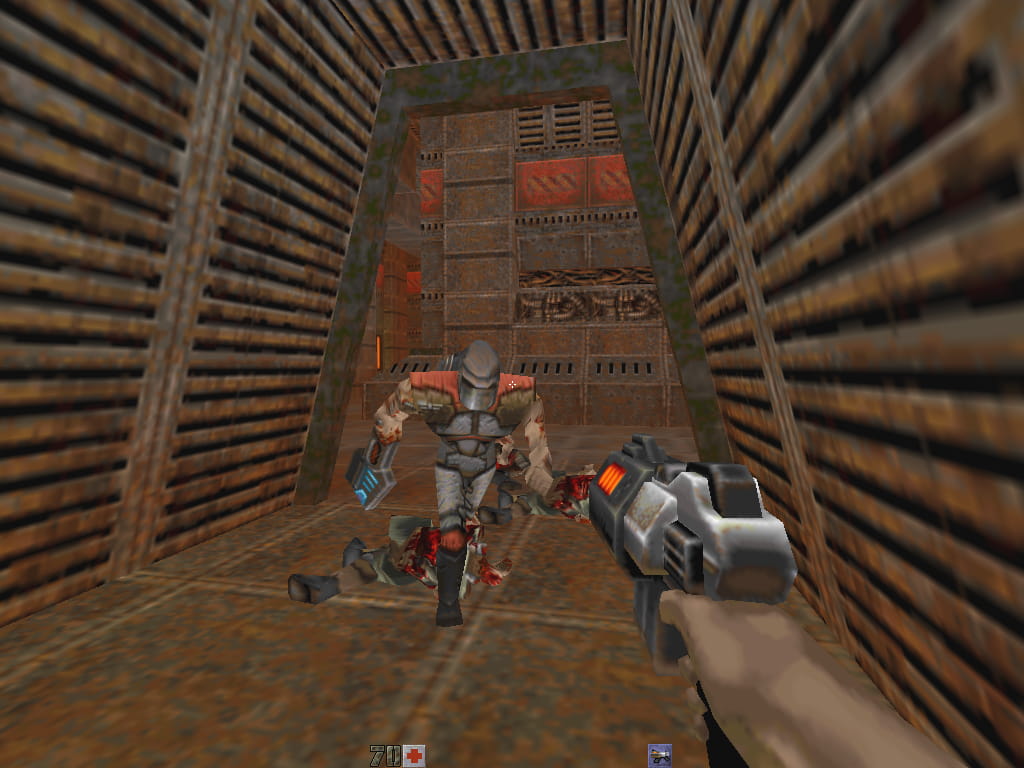
Quake II was officially released not only on PC, but also on PlayStation, Nintendo 64, and other platforms. The id Tech 2 engine incorporated development from several versions of the Quake Engine—GLQuake, Quake World, and WinQuake. Along with software rendering, the game initially included OpenGL support. Technologically, the engine is similar to the original Quake Engine, but has a number of significant differences—for example, its modular architecture: the renderer was moved to a separate DLL, allowing alternative rendering engines to be connected and switched between without recompiling the game.
In 2001, the id Tech 2 source code was released under the GPL. Some of the most famous games using this technology include Heretic II, SiN, Daikatana, and the Russian-made Spetsnaz: Anti-Terror.
Quare III: Arena
The third installment in the series was released in 1999. Quake III: Arena was originally conceived as a multiplayer shooter and lacked a full-fledged single-player mode—the goal of the single-player game was to engage in a stage-by-stage battle against bots. However, its extensive multiplayer mode, Q3's main strength, offered players four different online game modes: classic free-for-all deathmatch, team deathmatch, tournament, and capture the flag. Additional mods also implemented other modes, such as "Freeze Tag," "Rocket Arena," "Excessive," and "ExcessivePlus." There's also "Defrag," a mod for practicing movement and shooting accuracy.
The game used the id Tech 3 engine, which was significantly more resource-intensive than its predecessors. This turned off some fans—Quake II players were reluctant to switch to the third installment, citing its inconvenience, unfamiliarity, and resource-intensive nature. id Tech 3 was not based on the second version of the engine and was written from scratch. A technological breakthrough was the use of shaders to define materials.
Quake IV
In 2005, Quake IV was released, continuing the story of the battle between the humans and the Strogg. The player assumes the role of a commando participating in a counterattack on the Strogg capital planet. The story picks up a few weeks after the end of Quake II. Earth command, having learned of Macron's death, makes a second attempt to invade the planet Stroggos.
Quake IV uses the id Tech 4 engine, which also powers Doom 3 and many other games from id Software. This was another major technological breakthrough–at the time of its release, id Tech 4 was one of the most innovative game engines. It was originally planned as an extension of id Tech 3, but during development, the programmers decided to switch from C to C++, resulting in the engine being almost completely rewritten.
The engine was extremely resource-intensive for its time–initially, it required a graphics card with OpenGL 2.0 support and made extensive use of vertex and fragment shaders. Carmack warned gamers against purchasing GeForce 4 MX graphics cards because they only supported OpenGL 1.x, but ultimately, id Software added support for these cards to the engine.
The engine's main innovations were dynamic shaders-based per-pixel lighting, bump mapping, shadow volumes, and megatextures (which, however, were only used by one id Tech 4 game: Enemy Territory: Quake Wars). Doom 3 and Quake IV set the bar for commercial products—all these new technologies quickly became standard for AAA market. Incidentally, after the release of id Tech 5, the fourth version of the engine was released as free software under the GPL.
Enemy Territory: Quake Wars
After Quake IV, the company released another game that could be considered part of the Quake series–the tactical shooter Enemy Territory: Quake Wars (2007). Like the third game, it also focused on multiplayer, and its plot is a prequel to Quake II, taking place 50 years before its events.
This marks the end of the legendary shooter's series, but hopefully not forever. In 2011, John Carmack in an interview stated that the story of the confrontation between the humans and the Strogg had concluded, and if Quake 5 were ever released, its plot would, to some extent, continue the classic Quake with its universe of Lovecraftian monsters. However, in 2013, fans were met with sad news: Carmack left id Software to join the Oculus Rift virtual reality headset development team. Since then, id Software has been heavily focused on the Doom franchise, and nothing has been known about the fate of Quake.